Journey to the Center of the Earth
Dig your way down from an Icelandic volcano to the center of the Earth with Professor Lidenbrock, Axel and Hans.
Hamburg, 1863. Professor Lidenbrock has cracked a message in runes left by the alchemist Arne Saknussemm, and it says the way to the center of the Earth begins in the crater of an Icelandic volcano. You run the dig: diggers in the shafts, Axel at the lift, porters carrying ore up to the Professor’s desk. Every layer you open takes the expedition deeper into Verne’s story.
Get notified at launch
One email when the game comes out, and the occasional devlog. Nothing else, and you can unsubscribe at any time.
By signing up you agree to hear from us about the game. We store only your email, where you signed up and when. See our privacy policy.
From the devlog
The first devlog is in the making. Sign up above and we’ll tell you when it’s out.
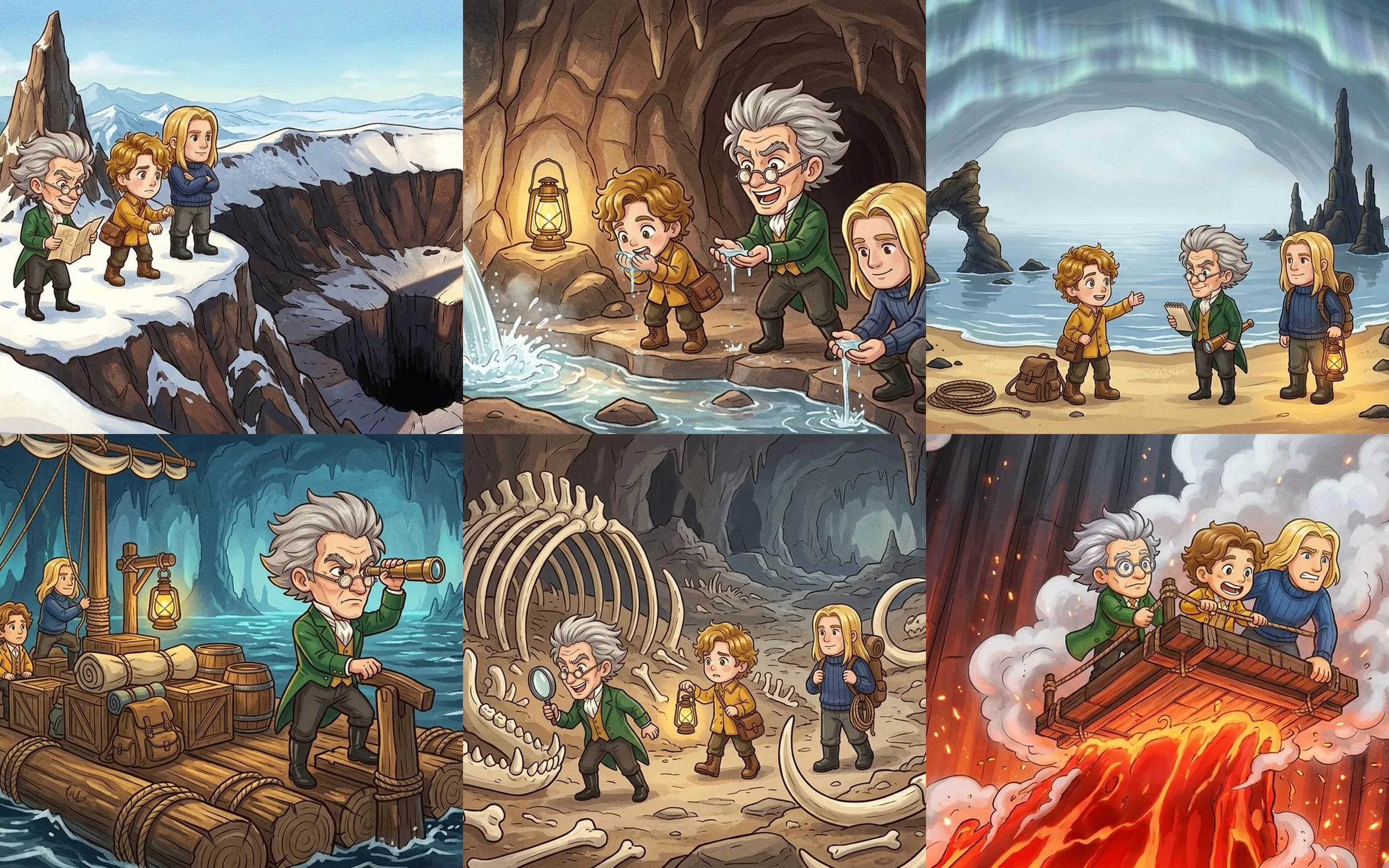
Seven layers down
Each layer of the mine is a stage of the novel, with its own rock, its own ore and its own camp. Open all five shafts, find Saknussemm’s three runes, and the way down opens.
Snæfellsjökull: into the crater
The Hansbach: water at last
The shores of the Lidenbrock Sea
Crossing the sea by raft
The Bone Plain
The Inner Fire
A look around
What you’ll do
Dig, haul, appraise
Diggers fill the bins in each shaft, the lift carries the ore up, and porters take it to the Professor’s desk, where it becomes thalers. Upgrade whichever is slowest, one level at a time or as many as you can afford, and watch the crews grow.
Seven layers deep
Go down from the crater of Snæfellsjökull through the lava galleries, the Hansbach, the Lidenbrock Sea, the Bone Plain and the Inner Fire. Each layer has five shafts with its own ore, and three of Saknussemm’s runes to find before you can go deeper. The layers you leave keep sending up supplies.
Put people in charge
Axel runs the lift, Hans works wherever he’s needed, and the Professor leads the deepest shaft. Each has an ability, with a bonus for using all three together. Hire foremen from the hiring board and the mine keeps working while you’re away.
Specimens and research
Your diggers turn up specimens as they work. Fill a Specimen Cabinet of 70 finds, ten from each layer, and spend specimens on nine kinds of research, from better pickaxes to a steam hoist. A daily Expedition Log sets you three new tasks.
The story as you dig
Illustrated story pages open and close every layer, and Axel keeps a journal as you go. The expedition runs short of water, Axel gets lost in the dark, sea monsters fight around the raft, a storm blows up, and at the end there is a rock to blast.
Start again, go further
The blast sends the expedition back to the surface, and you can set out again with Renown that raises your income for good. New expeditions unlock the Lost Chapters of Saknussemm’s own journey, and after three, the way opens to the Center itself.
Who you’ll meet

Professor Lidenbrock
Brilliant, impatient and certain. He leads the deepest shaft, and science waits for no one.

Axel
The Professor’s nephew, who would rather be at home. He works the lift and writes the journal.

Hans Bjelke
The Icelandic guide. He says almost nothing and works wherever he is needed.

The foremen
Icelanders you hire from the hiring board to run a shaft or the camp, each with a knack for speed or for value.
Devlog
Made by one person, with a lot of help from AI, and documented as it goes: what worked, what didn’t, and what it cost.
The first episodes are on their way.
Questions
- What can I play it on?
- iPhone, played in portrait.
- When will it come out?
- It’s in testing now. Sign up above and we’ll write when it’s ready.
- How much will it cost?
- The price isn’t decided yet.
- Do I need to have read the book?
- No. The story is told as you dig, in illustrated pages and Axel’s journal. If you know the novel, you’ll recognise a great deal, from the runes in Hamburg to the raft on the sea of lava.
- Does it keep going when I’m not playing?
- Yes, once someone is in charge of every station. When you come back, the expedition hands over what it earned while you were away, up to a limit that research can raise.
- How was it made?
- By one person, with AI tools for the art and much of the code, and every piece reviewed by hand. The sounds and music are synthesised by a small program rather than recorded.